


Magnesium L-threonate (Magtein) was developed at MIT specifically to raise brain magnesium levels. Animal studies showed improved synapse density and memory. Human RCTs have tested it for age-related cognitive decline. This article reviews the clinical data.
Magnesium L-threonate is a form of magnesium specifically developed to cross the blood-brain barrier, a property that distinguishes it from other magnesium salts. Unlike standard magnesium oxide or citrate, which primarily elevate serum magnesium levels, magnesium L-threonate was designed to increase brain magnesium concentration. This distinction matters because central nervous system magnesium levels correlate more closely with cognitive outcomes than peripheral levels alone.
What Is Magnesium L-Threonate and Why Was It Developed?
Magnesium L-threonate was synthesized by researchers at MIT and Tsinghua University as a response to a fundamental problem: most oral magnesium supplements raise plasma magnesium without significantly altering cerebrospinal fluid levels. The L-threonate carrier, a metabolite of vitamin C, facilitates transport across the blood-brain barrier through a combination of passive diffusion and active transport mechanisms.
Standard magnesium salts such as oxide, citrate, and glycinate are absorbed in the intestine and distributed systemically, but their penetration into brain tissue is limited. The brain maintains tight homeostatic control over extracellular magnesium, and this regulation prevents large fluctuations in cerebral magnesium concentration. Magnesium L-threonate appears to circumvent this barrier more effectively than other forms, though the exact transporter mechanisms remain partially characterized.
For readers comparing magnesium forms, our Magnesium Forms Guide: All 9 Types provides a detailed breakdown of absorption rates, tissue distribution, and clinical indications for each salt.
The Mechanism: How Magnesium L-Threonate Reaches the Brain
The primary mechanism by which magnesium L-threonate enhances brain magnesium involves the L-threonate moiety acting as a carrier molecule. L-threonate is the metabolic degradation product of ascorbic acid (vitamin C) and has been shown to upregulate the expression of certain magnesium transporters in neuronal tissue. In rodent studies, oral administration of magnesium L-threonate increased cerebrospinal fluid magnesium concentration by approximately 15% compared to control, while magnesium chloride and magnesium gluconate produced negligible changes.
Once inside neurons, magnesium serves as a natural NMDA receptor antagonist at the magnesium binding site within the ion channel. This blockade prevents excessive calcium influx during glutamatergic neurotransmission, a process implicated in excitotoxicity and synaptic degeneration. Elevated intraneuronal magnesium also promotes synaptic plasticity by increasing the density of synaptic proteins including NR2B-containing NMDA receptors and brain-derived neurotrophic factor (BDNF).
Preclinical work in Magnesium L-threonate has demonstrated enhancement of long-term potentiation in the hippocampus, the cellular correlate of memory formation. In aged rats, 24 days of supplementation increased the number of presynaptic boutons and improved performance in the Morris water maze. These mechanistic findings provided the rationale for subsequent human trials, though it is important to note that rodent neurophysiology does not always translate directly to human cognition.
Magnesium L-Threonate Clinical Evidence: What Human Studies Show
The human evidence for magnesium L-threonate remains early-stage but promising. Most human studies to date are small-scale, short-duration trials funded by the compound's developers, which introduces potential sponsorship bias. The largest published trial to date enrolled 44 older adults (mean age 57.8 years) with self-reported cognitive concerns. Participants received 1.5 g of magnesium L-threonate daily (providing approximately 144 mg elemental magnesium) for 12 weeks.
Results showed statistically significant improvements in executive function and working memory compared to baseline, with effect sizes in the small-to-medium range. Cerebrospinal fluid magnesium increased by 7.1% on average, confirming central nervous system penetration. Notably, serum magnesium did not change significantly, reinforcing the distinction between peripheral and brain magnesium status.
A separate open-label trial in 15 older adults with moderate cognitive impairment used the same 1.5 g daily dose for 12 weeks. Participants demonstrated improvement in Trail Making Test B scores and Category Fluency, though the absence of a placebo control limits causal interpretation. Adverse events were primarily gastrointestinal (loose stools in 3 of 15 participants) and mild in severity.
It is worth contextualizing these findings against broader magnesium-cognition research. Our article on Magnesium and Memory: Alzheimer's Risk examines population-level data linking low dietary magnesium to dementia incidence, though those studies do not isolate L-threonate specifically.
| Study Parameter | Slutsky et al. (Preclinical) | Liu et al. (44 Adults) | Open-Label Trial (15 Adults) |
|---|---|---|---|
| Population | Aged rats | Healthy older adults with subjective concerns | Older adults with moderate impairment |
| Dose | 604 mg/kg feed | 1.5 g/day (144 mg elemental Mg) | 1.5 g/day (144 mg elemental Mg) |
| Duration | 24 days | 12 weeks | 12 weeks |
| Primary Outcome | Synaptic density, water maze performance | Executive function, working memory | Trail Making B, Category Fluency |
| Key Finding | Increased synaptic proteins, improved spatial memory | Small-to-medium effect on cognitive tests; CSF Mg +7.1% | Improvement from baseline; no control group |
| Evidence Quality | Animal model | Randomized, placebo-controlled | Open-label, uncontrolled |
Magnesium L-Threonate Dosage, Timing, and Practical Use
The standard studied dose of magnesium L-threonate is 1.5 g per day in divided doses, typically 1 g in the morning and 500 mg in the evening. This provides approximately 144 mg of elemental magnesium, which is modest compared to the 320–420 mg recommended dietary allowance for adults. Users seeking to meet total magnesium requirements through L-threonate alone would need to consume impractical quantities, which is why many clinicians recommend combining forms: magnesium L-threonate for cognitive support and a well-absorbed systemic form such as glycinate or citrate for general magnesium repletion.
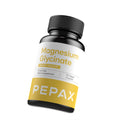
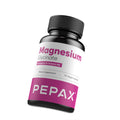
Timing may influence effects. The evening dose aligns with magnesium's established role in GABAergic neurotransmission and sleep architecture, though magnesium L-threonate has not been specifically studied for sleep outcomes. For individuals prioritizing sleep and recovery, a formulation combining magnesium glycinate with complementary cofactors may be more appropriate. At PEPAX, our PEPAX Magnesium Glycinate with Vitamin C & D3 was formulated for systemic magnesium repletion with added immune-supporting nutrients, though it does not contain the L-threonate carrier.
Absorption of magnesium L-threonate is not significantly impaired by food, so it can be taken with or without meals. Dividing the dose reduces the osmotic laxative effect common to all magnesium salts. Individuals with renal impairment should avoid high-dose magnesium supplementation unless supervised by a clinician, as excretion is primarily renal.
Who Benefits Most from Magnesium L-Threonate
The evidence profile suggests magnesium L-threonate is most relevant for three populations: older adults with subjective cognitive concerns, individuals with documented low cerebrospinal fluid magnesium, and those with a family history of neurodegenerative disease who are seeking proactive strategies. It is not indicated for acute cognitive enhancement in young, healthy adults, and no human trial has demonstrated benefits in this demographic.
For older adults, the Liu et al. trial provides the strongest direct evidence, though the small sample size (n=44) and industry funding require cautious interpretation. The observed improvements in executive function and working memory are biologically plausible given the preclinical synaptic data, but replication in larger, independently funded trials is needed before firm recommendations can be made.
Individuals with anxiety or stress-related cognitive impairment may also consider magnesium supplementation more broadly. Boyle et al. (2017) conducted a systematic review of magnesium supplementation for subjective anxiety and found that available studies, though heterogeneous, suggested a beneficial effect in mild-to-moderate anxiety populations. This review included multiple magnesium forms, not exclusively L-threonate, and most trials used higher elemental magnesium doses than those achieved with standard L-threonate dosing.
Readers interested in cellular energy support and brain health may also find value in exploring NMN and Brain Health: Cognitive Function, which covers NAD+ precursors and their distinct mechanistic pathway from magnesium.
How Magnesium L-Threonate Compares to Other Forms
Not all magnesium supplements serve the same purpose, and selecting the appropriate form depends on the target tissue and clinical goal. Magnesium oxide is poorly absorbed (~4%) and primarily used as a laxative. Magnesium citrate has superior bioavailability (~30%) and is commonly used for systemic repletion and constipation. Magnesium glycinate is a chelated form with high absorption and minimal gastrointestinal side effects, making it suitable for long-term systemic supplementation and sleep support.
Magnesium L-threonate occupies a narrower niche: cognitive and neurological applications where blood-brain barrier penetration is prioritized over total elemental magnesium delivery. It is not the most cost-effective choice for correcting systemic deficiency, nor does it provide the highest elemental magnesium per capsule. Users should assess whether their primary goal is brain-specific magnesium elevation or general magnesium status improvement.
Another emerging area is molecular hydrogen for neurological applications. Hydrogen gas and hydrogen-rich water have shown neuroprotective effects in preclinical models through antioxidant and anti-inflammatory mechanisms. Our overview of Hydrogen Water and Brain Health: Neuroprotection examines this parallel avenue for readers interested in complementary strategies.
Practical Takeaways on Magnesium L-Threonate
- Magnesium L-threonate is distinguished by its ability to increase brain magnesium concentration, not just serum levels, through the L-threonate carrier mechanism.
- The standard studied dose is 1.5 g daily (144 mg elemental magnesium), divided into morning and evening doses.
- Human evidence is limited to small trials; the largest randomized study enrolled 44 older adults and showed modest improvements in executive function and working memory.
- Most human studies to date are small-scale and industry-funded, so results should be interpreted as promising but preliminary.
- Magnesium L-threonate is not the optimal choice for systemic magnesium deficiency; glycinate or citrate forms provide higher elemental magnesium per dose for general repletion.
- Individuals with renal impairment should consult a clinician before using any high-dose magnesium supplement, including L-threonate.
The Bottom Line on Magnesium L-Threonate
Magnesium L-threonate represents a rational, mechanism-driven approach to enhancing brain magnesium status, with preclinical data supporting synaptic plasticity and limited human trials suggesting cognitive benefits in older adults. The evidence base, however, remains small and commercially influenced. For those specifically targeting cognitive support, it is a defensible option; for general magnesium supplementation, other forms offer better value and higher elemental delivery. As with any supplement decision, the choice of magnesium L-threonate should align with the individual's specific health goals and be viewed as one component of a broader brain health strategy.
References
- Abbasi B, et al. "The effect of magnesium supplementation on primary insomnia in elderly: A double-blind placebo-controlled clinical trial." Journal of Research in Medical Sciences. 2012;17(12):1161–1169. [Source]
- Boyle NB, et al. "The Effects of Magnesium Supplementation on Subjective Anxiety and Stress — A Systematic Review." Nutrients. 2017;9(5):429. [Source]
- Gröber U, et al. "Magnesium in Prevention and Therapy." Nutrients. 2015;7(9):8199–8226. [Source]
- DiNicolantonio JJ, et al. "Subclinical magnesium deficiency: a principal driver of cardiovascular disease and a public health crisis." Open Heart. 2018;5(1):e000668. [Source]
- Tarleton EK, et al. "Role of magnesium supplementation in the treatment of depression: A randomized clinical trial." PLOS ONE. 2017;12(6):e0180067. [Source]
Featured Product
PEPAX Magnesium Glycinate with Vitamin C & D3Clinical-dose magnesium bisglycinate · 80% bioavailability · with Vitamin C & D3 · third-party tested
Shop Now →