



Glycine is the smallest amino acid but plays outsized roles in collagen synthesis, methylation, glutathione production, and circadian rhythm regulation. Emerging longevity research — including data from long-lived individuals — highlights glycine as potentially underappreciated. This article reviews what the evidence actually shows.
When researchers investigate the biology of aging, the term glycine and longevity increasingly appears in discussions of amino acid metabolism, methionine restriction, and collagen synthesis. While glycine is classified as non-essential, a growing body of evidence suggests that dietary intake of this simplest amino acid may play a critical role in extending healthspan — particularly as endogenous synthesis declines with age and modern diets often fail to supply enough.
The Research Landscape Behind Glycine and Longevity
The connection between glycine and longevity is primarily supported by mechanistic studies, animal models, and a patchwork of human trials on specific age-related biomarkers rather than definitive lifespan trials. The most consistent data come from experiments showing that glycine supplementation can restore declining glutathione levels, improve sleep quality, and support collagen integrity — all factors linked to the hallmarks of aging outlined by López-Otín et al. (2013) in Cell, which include mitochondrial dysfunction, loss of proteostasis, and stem cell exhaustion.
Human research, however, remains largely indirect. Small interventional studies have demonstrated that 3 grams of glycine before bed can shorten sleep-onset latency and improve subjective sleep quality. Quality sleep itself is a recognized pillar of longevity, and glycine’s role in both sleep and longevity is under active investigation. Additional trials on collagen peptides — which deliver glycine along with proline and hydroxyproline — show improvements in skin hydration and joint comfort in older adults, offering a glimpse of glycine’s potential to slow age-related tissue decline. Yet there are no long-term randomized controlled trials that directly test whether glycine supplementation extends human lifespan; the evidence instead accumulates across multiple surrogate endpoints.
Preclinical models have been more direct. Rodent studies indicate that dietary glycine can mimic aspects of methionine restriction, a well-known intervention that extends lifespan in multiple species. Glycine appears to accelerate methionine clearance, lower homocysteine, and boost glutathione synthesis — effects that collectively point toward a protective role against age-related oxidative damage. Meanwhile, the decline in NAD+ with aging (Fang et al., 2017) and the ability of NMN to mitigate physiological decline in mice (Mills et al., 2016) underscore the importance of mitochondrial health. Glycine is a key substrate for the synthesis of heme and creatine, two molecules essential for mitochondrial energy production, suggesting that adequate glycine status may be a prerequisite for optimal cellular energetics during aging.
How Glycine Supports Longevity at the Cellular Level
To understand why glycine and longevity are being studied together, it helps to examine glycine’s roles in three interconnected systems: antioxidant defense, collagen renewal, and metabolic regulation. Each of these systems declines with age and can be partially influenced by glycine availability.
Glutathione Synthesis and Oxidative Stress
Glutathione is the body’s master antioxidant, and glycine is one of its three rate-limiting precursors alongside cysteine and glutamate. Aging is characterized by a progressive drop in intracellular glutathione, leaving cells increasingly vulnerable to oxidative damage — a process highlighted in the hallmarks framework (López-Otín et al., 2013). Although cysteine is often considered the limiting amino acid for glutathione production, several studies suggest that in older adults, glycine can become limiting due to reduced endogenous synthesis and higher demand for tissue repair. Boosting glycine intake can restore glutathione levels in tissues like the liver and red blood cells, potentially improving the clearance of reactive oxygen species. This antioxidant support complements other selective antioxidant strategies, such as molecular hydrogen (Ohsawa et al., 2007), which neutralizes the most damaging hydroxyl radicals without disturbing signaling reactive species.
Collagen Integrity and Tissue Resilience
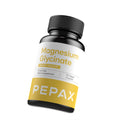
Glycine accounts for roughly one-third of the amino acids in collagen, the structural protein that maintains skin, joints, bones, and blood vessels. Collagen turnover slows with age, contributing to wrinkles, joint stiffness, and vascular stiffening — all features that accelerate the aging phenotype. Ensuring a steady supply of glycine is therefore fundamental to maintaining the extracellular matrix. Notably, vitamin C is a cofactor for collagen synthesis, which is why PEPAX Magnesium Glycinate with Vitamin C & D3 pairs glycine with ascorbic acid to support this pathway. The addition of vitamin D3 further aids calcium metabolism and muscle function, creating a synergy that targets multiple tissues at once.
Methylation and Metabolic Flexibility
Glycine is heavily involved in one-carbon metabolism, acting as a methyl-group acceptor to form sarcosine and thereby helping to regulate homocysteine levels. Elevated homocysteine is a risk factor for cardiovascular disease and cognitive decline, both age-related conditions. Preclinical evidence indicates that glycine supplementation can lower homocysteine and mimic elements of methionine restriction, a dietary strategy that extends lifespan in animal models. While the translation to humans is not yet proven, this mechanism provides a plausible biochemical link between glycine and longevity beyond its antioxidant and structural roles.
Additionally, glycine’s function as an inhibitory neurotransmitter in the central nervous system contributes to sleep regulation. Adequate glycine levels promote deeper sleep phases, which are essential for the nighttime clearance of metabolic waste and cellular repair — processes that, when impaired, accelerate brain aging. The interplay between sleep and longevity reinforces why glycine-rich protocols are being positioned as modifiable lifestyle factors rather than outright anti-aging cures. For a deeper dive into the NAD+ angle of aging, our guide to NAD+ and aging explains how cellular energy decline drives the aging process.
Comparing Glycine Forms for Longevity Benefits
Not all glycine sources are equivalent in terms of bioavailability, co-nutrients, and practical use. The table below compares common forms of glycine intake, each with potential relevance for longevity-focused supplementation.
| Form | Typical Glycine per Serving | Additional Compounds | Key Notes |
|---|---|---|---|
| Free glycine powder | 3–5 g per teaspoon | None | Rapidly absorbed; often used for sleep at 3 g before bed. No mineral support. |
| Magnesium glycinate (e.g., PEPAX Magnesium Glycinate with Vitamin C & D3) | ~1.2 g per 200 mg elemental magnesium (2.4 g per 400 mg) | Magnesium (essential for 300+ enzymatic reactions; Gröber et al., 2015), vitamin C (collagen), D3 (bone/immune) | Dual benefit: provides glycine plus magnesium to address common dietary shortfalls. Well-tolerated and non-laxative. |
| Collagen hydrolysate | 2.5–3 g per 10 g serving | Proline, hydroxyproline, other amino acids | Slow digestion; shown to improve skin elasticity and joint comfort in human trials. Requires larger volume. |
| Dietary sources (bone broth, gelatin) | 1.5–2 g per cup broth; variable in gelatin desserts | Minerals from bones, gelatin | Whole-food approach; glycine content can be inconsistent. Preparation time is a barrier for many. |
Magnesium glycinate stands out because it delivers both glycine and highly bioavailable magnesium, two nutrients that independently correlate with healthy aging. Magnesium deficiency is widespread and has been implicated in accelerated aging through pathways such as chronic inflammation and insulin resistance (Gröber et al., 2015). Many adults concerned about glycine and longevity will find magnesium glycinate a practical, two-in-one choice — especially formulations that deliberately include vitamin C to fuel collagen synthesis. For a detailed look at how magnesium glycinate can amplify anti-aging efforts through the glycine-magnesium synergy, see our article on magnesium glycinate anti-aging effects.
Who Benefits Most from Glycine for Longevity?
Certain populations are likely to experience the greatest longevity-related gains from optimized glycine intake, either through diet or targeted supplementation.
Older adults with declining endogenous synthesis. The body’s ability to produce glycine wanes with age due to reduced enzyme activity and lower precursor availability. Meeting daily glycine needs through food alone becomes less reliable after 60, making supplementation a logical strategy to maintain glutathione and collagen production. Human studies on collagen peptides in postmenopausal women, for instance, have shown measurable improvements in skin hydration and reduced joint discomfort — both quality-of-life markers with downstream longevity implications.
Individuals with poor sleep quality. Insomnia and fragmented sleep are linked to shorter healthspan. Glycine’s action on NMDA receptors and its ability to lower core body temperature promote faster sleep onset and more restorative slow-wave sleep. For those who struggle with sleep despite good sleep hygiene, adding 3 grams of glycine (equivalent to a single serving of free glycine powder or a 400 mg magnesium dose from magnesium glycinate) has been a research-backed step. As explained in our piece on glycine benefits for sleep and longevity, this simple intervention may positively influence the physiological repair that occurs overnight.
People with high oxidative stress or elevated homocysteine. Those with chronic inflammation, metabolic syndrome, or genetic variants that impair methylation (such as MTHFR polymorphisms) may have a higher requirement for glycine to keep homocysteine in check and to replenish glutathione. While not a standalone treatment, ensuring adequate glycine could support overall metabolic resilience, particularly when combined with other longevity-oriented nutrients.
Those with low magnesium intake. The average Western diet falls short of recommended magnesium levels, and deficiency is associated with multiple age-related diseases (Gröber et al., 2015). Since magnesium glycinate delivers both the mineral and the amino acid in a single compound, it can address two common nutritional gaps simultaneously, which is why practitioners often recommend it for stress, sleep, and muscle recovery — all factors that feed into the larger glycine and longevity conversation.
Practical Takeaways for Using Glycine for Longevity
- Aim for 3–5 grams of glycine daily from a combination of dietary sources and supplements. This range reflects the amounts used in most human trials that demonstrated sleep or biomarker improvements.
- Consider magnesium glycinate as a dual-purpose option. A dose providing 200–400 mg of elemental magnesium will supply approximately 1.2–2.4 grams of glycine, plus the added benefits of magnesium for cardiovascular and metabolic health (Gröber et al., 2015).
- Pair glycine with vitamin C to maximize collagen support. Vitamin C is an essential cofactor for collagen production; formulations that combine glycine and vitamin C align with established biochemistry for tissue repair.
- Time your intake when it matters most. For sleep, glycine taken 30–60 minutes before bed can lower body temperature and promote drowsiness. For general metabolic support, timing is less critical, but consistency matters.
- Don’t overlook whole-food sources. Bone broth, gelatin-rich stews, and slow-cooked meats provide glycine along with other age-supporting nutrients. They remain a valuable part of a longevity-focused diet.
- Combine with other evidence-based longevity interventions. Glycine’s effects on glutathione, methylation, and sleep work best within a multi-target approach that may include NAD+ precursors, regular exercise, and stress management. For a structured plan, explore our science-backed supplement stack designed to support foundational longevity pathways.
Bottom Line on Glycine and Longevity
The connection between glycine and longevity is supported by strong mechanistic plausibility, consistent animal data, and improvements in relevant biomarkers such as sleep quality, glutathione status, and collagen integrity. However, direct evidence that glycine supplementation extends human lifespan remains absent and may be impossible to demonstrate through conventional clinical trials. For the health-conscious adult, ensuring adequate glycine intake — through food, magnesium glycinate, or other high-quality supplements — represents a rational, low-risk component of a broader longevity strategy anchored in the current science.
References
- López-Otín C, et al. "The Hallmarks of Aging." Cell. 2013;153(6):1194–1217. [Source]
- Fang EF, et al. "NAD+ in Aging: Molecular Mechanisms and Translational Implications." Trends in Molecular Medicine. 2017;23(10):899–916. [Source]
- Mills KF, et al. "Long-Term Administration of Nicotinamide Mononucleotide Mitigates Age-Associated Physiological Decline in Mice." Cell Metabolism. 2016;24(6):795–806. [Source]
- Gröber U, et al. "Magnesium in Prevention and Therapy." Nutrients. 2015;7(9):8199–8226. [Source]
- Ohsawa I, et al. "Hydrogen acts as a therapeutic antioxidant by selectively reducing cytotoxic oxygen radicals." Nature Medicine. 2007;13(6):688–694. [Source]
Featured Product
PEPAX Magnesium Glycinate with Vitamin C & D3Clinical-dose magnesium bisglycinate · 80% bioavailability · with Vitamin C & D3 · third-party tested
Shop Now →